


Introduction
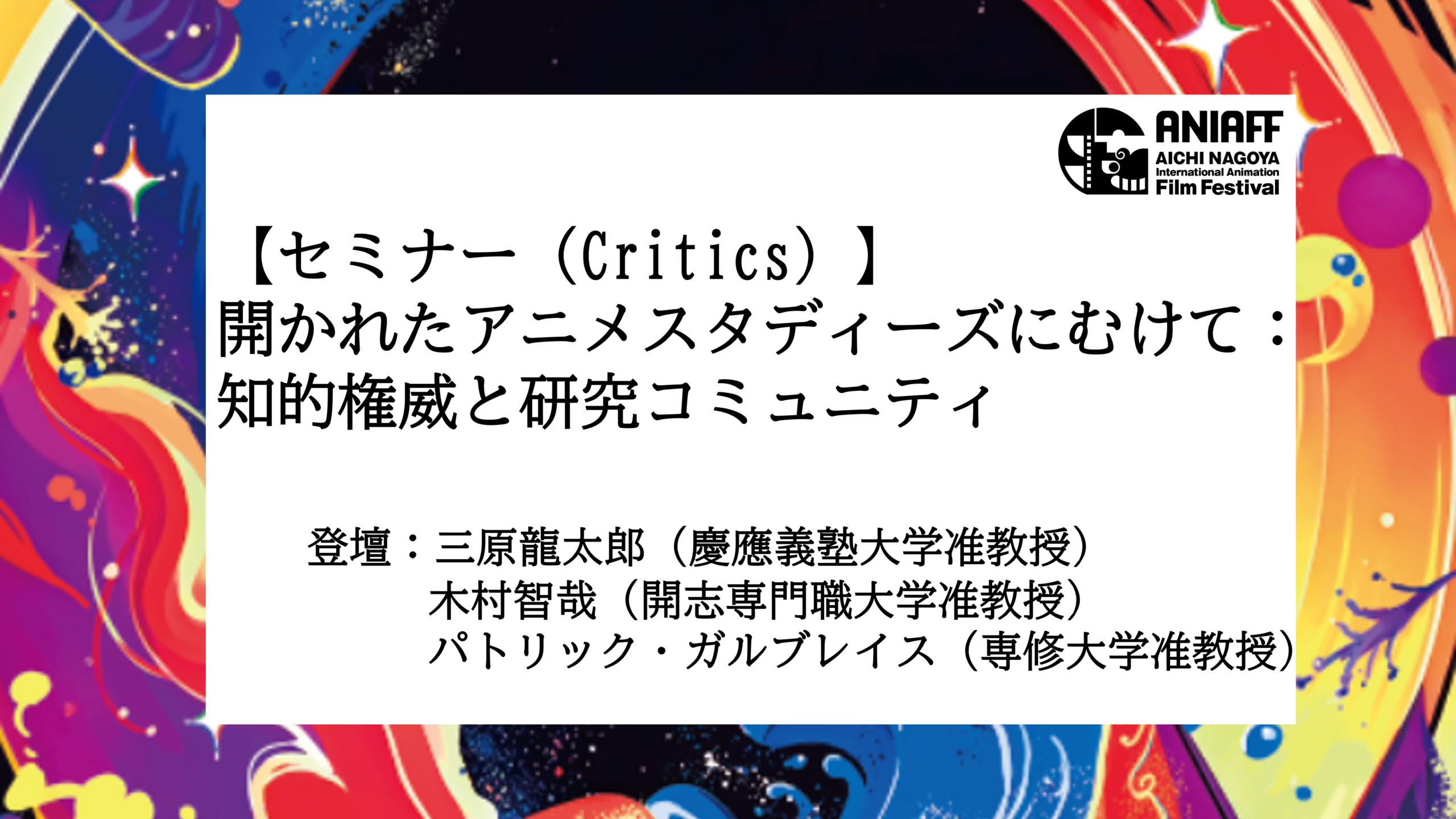
Parallel to the globalization of Japanese animation that has taken place in the past three decades, Anglophone anime studies has become the major point of reference for anyone trying to approach the emerging field intellectually. Few scholars, however, have interrogated how Anglophone anime studies has established its academic authority over other research communities around the world. Also rare is reflection on the ways that this intellectual community of Anglophone anime studies sustains and reproduces its authority. In response, this panel scrutinizes the socio-historical process by which Anglophone anime studies has come to occupy its elevated position especially against Japanophone anime studies. The panel explores pathways forward to deconstruct the existing authoritative intellectual straightjacket, and, in so doing, envision anime studies as a more open field of research.
Speaker
Speaker:Ryutaro Mihara
A cultural anthropologist and Associate Professor in the Faculty of Economics at Keio University.
He completed his D.Phil. (PhD) in Anthropology at the University of Oxford in 2017.
His research specializes in the overseas development of creative industries, particularly anime. After serving as Assistant Director at the Ministry of Economy, Trade and Industry—where he helped establish the Creative Industries Division—and as Lecturer in the School of Finance and Management at SOAS, University of London, he assumed his current position in 2020.
Since 2018, he has also served as Overseas Development Advisor (now International Business Advisor) for Arch Inc.
Speaker:Patrick W. Galbraith
Patrick W. Galbraith is an Associate Professor in the Faculty of International Communication at Senshu University. After earning his PhD in Information Studies from the Graduate School of Interdisciplinary Information Studies at the University of Tokyo, he obtained a PhD in Cultural Anthropology from Duke University. His major works include Otaku and the Struggle for Imagination in Japan (Duke University Press, 2019) and The Ethics of Affect: Lines and Life in a Tokyo Neighborhood (Stockholm University Press, 2021).
Speaker:Tomoya Kimura
Tomoya Kimura is an Associate Professor of the Faculty of Anime and Manga at Kaishi Professional University, holding a Ph.D. in Literature. His research centers on the history of media industries, with a particular focus on animation. Prior to his current position as a visiting researcher at the National Film Archive of Japan, Kimura worked as a research assistant at the Waseda University Theatre Museum and as a part-time lecturer at various other universities. His was known for his award-winning monograph"A Historiography of Toei Animation: The Undercurrents of Management and Creation" (Nippon Hyoronsha, 2020), with the 2021 Japan Society for Animation Studies (JSAS) Award. His other publications include the book chapter, "Diversified Management of the Five Major Companies during the Decline of the Japanese Film Industry: Based on Business Records and Oral Histories," in Film's Survival Strategies: Cross-industry Entry, Digitalization, and Archiving (edited by Kenji Tanigawa, Shinwasha, 2024), and the journal article, "Between Curation and Amusement: On the Nature of Animation-Related Exhibitions," in Studies in Audiovisual Narrative Arts, No. 2 (Kaishi Professional University, 2025).